Azadirachta indica
Neem,Nim tree or Indian lilac
Description
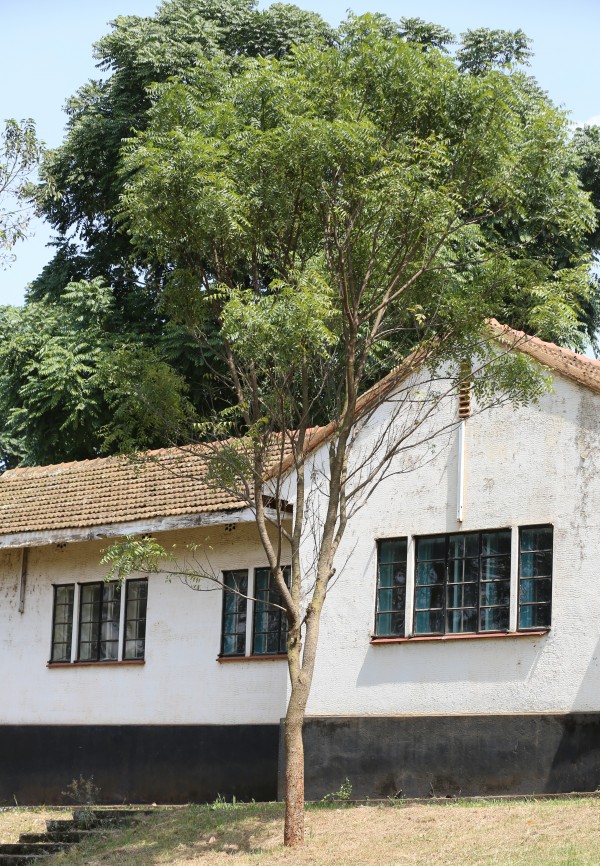
Neem is a long-lived evergreen tree with a wide-spreading, dense, ovoid crown; it can grow about 15 meters tall with occasional specimens up to 25 meters. It has a short, straight bole that can be 100cm in diameter, and long, spreading branches that form a dense, large, oval or rounded crown.
BARK: pale greybrown, grooved and rough at maturity.
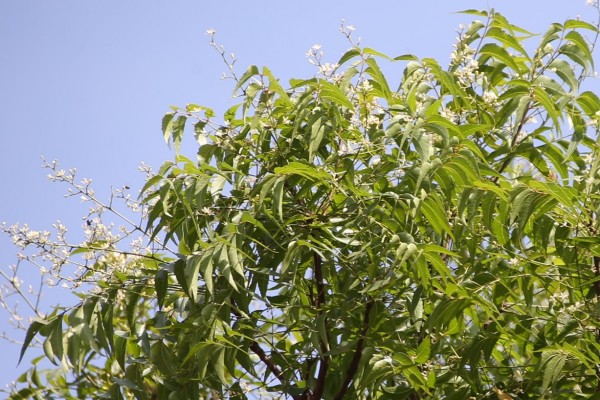
LEAVES: glossy green, alternate, crowded at the ends of branches, pinnate to 40 cm long, eachleaflet curved and long pointed, the edge roughly saw toothed, leaf blades unequal, a small leaflet at the leaf tip.
FLOWERS: small, fragrant, creamy white, hanging in long graceful sprays.
FRUIT: oval yellow berries when ripe, 2 cm long, thin skinned with oily pulp around 1-2 seeds.
Uses
Edible: the fruits are eaten fresh or cooked, or prepared as a dessert or lemonade-type drink, young leaves and flowers can be cooked and eaten as a pre-meal appetizer though they very bitter flavour, Sap obtained from the branches and roots is fermented and drunk. http://tropical.theferns.info/viewtropical.php id=Azadirachta+indica
Medicine: leaf teas, an oil extracted from the seed, the twigs, bark, neem oil, neem leaf paste. http://tropical.theferns.info/viewtropical.php id=Azadirachta+indica , http://natureconservation.in/description-and-medicinal-uses-of-azadirachta-indica-neem/
The bark of the yields, and the fiber that is woven into ropes.
The large crown makes it an effective shade tree.
An ornamental (avenue) tree.
Agroforestry: can be used as a windbreak, provides fodder (leaves, oil-seed cake) for the animals, provides forage to the bees, promotes soil conservation.
The dried leaves are insect repellent, they are used like mothballs in linen cupboards and also placed within books in libraries. http://tropical.theferns.info/viewtropical.php id=Azadirachta+indica
A non-drying oil (margosa oil) extracted from the seed is used in hair dressings.
The oil can also be used as a fuel in lamps.
The margosa oil is used for soaps, cosmetics, pharmaceuticals and other non-edible products.
A resin got from the trunk by wounding it, is added to soap, toothpaste and skin lotions. This high-protein material has potential as a food additive and is widely used in Southeast Asia as 'neem glue. http://tropical.theferns.info/viewtropical.php id=Azadirachta+indica
The tree bark is a source of tannins.
The wood is a source of timber which is used to make wardrobes, bookcases and closets, as well as packing cases because of its insect repellent quality.
The main stem of the tree is used to make poles for construction or fencing because the wood is termite resistant.
Provides charcoal and firewood.
Neem seed pulp is useful for methane gas production. http://natureconservation.in/description-and-medicinal-uses-of-azadirachta-indica-neem/
Ecology
It is a well-known tree in its natural range (India) and today widely planted in Africa, Pan-tropical in semi-arid and arid regions, withstanding drought. Normally it thrives in areas with sub-arid to sub-humid conditions, with an annual rainfall of 400 1,200 millimeters (16 47 in). It can grow in regions with an annual rainfall below 400 mm, but in such cases it depends largely on ground water levels. Neem can grow in many different types of soil, but it thrives best on well drained deep and sandy soils. The tree has been introduced and established throughout the tropics and subtropics for its highly valued hardiness, it's almost year-round shade, and its multiple wood and non-wood products. In Uganda it grows very well in lowland areas of Moroto, Kotido, Soroti, Kumi and Mbale Districts. Roots grow deep and spread over a wide area; and it does not stand waterlogging areas. In Kampala, Neem tree can be found within Sheraton gardens, Uganda Golf course club, Makerere university, at Mackenzie Vale road, Bombo Road among other places.
Management
Fast growing; lopping, pollarding.
Tree gallery
.jpg)
.jpg)