
An AFRDA Initiative | Established 2025
From skills to work across Africa
AIM-Bridge Africa stands for Apprenticeship, Innovation, Mobility and Business Readiness for TVET Graduates. It is a practical bridge between certification and real opportunity.

Johnathan Walugembe
First Cohort Participant
A stronger bridge between graduation and opportunity
The initiative is the missing transition infrastructure between technical qualification and sustained economic participation.
AFRDA is building a stronger bridge between TVET graduation and real opportunity by connecting young people to apprenticeships, cross-border industry placements, business readiness support and regional mobility pathways that turn technical skills into employment, enterprise and long-term potential.
Talent should not be trapped by geography
A young person in Uganda or Kenya may gain a transformative opportunity in Ghana. A young technician in Rwanda may learn something in Nigeria that changes the trajectory of their career. A graduate who crosses a border for structured industrial exposure gains hands-on experience and learns professional culture, discipline, systems, standards, teamwork, adaptability and regional confidence.
African Union policy already recognises the value of labour mobility and the exchange of young workers. AIM-Bridge Africa turns that policy direction into a practical pathway for real young people.
Opportunity moves
The challenge is both training & transition.
Across Africa, too many technically trained young people leave school with real skills but too little access to real opportunity. They finish with certificates, but employers often ask for prior experience.
Others start small workshops or service businesses, yet struggle because technical training alone does not always prepare them to manage enterprises, staff, customers, cash flow, growth or market access. That is the missing bridge AIM-Bridge Africa was designed to solve.
Certificate without experience
Employers ask for the very thing graduates do not yet have.
Skills without market access
Workshops survive on capacity, not strategy or customers.
Talent trapped by geography
Opportunity stops at borders that talent could cross.
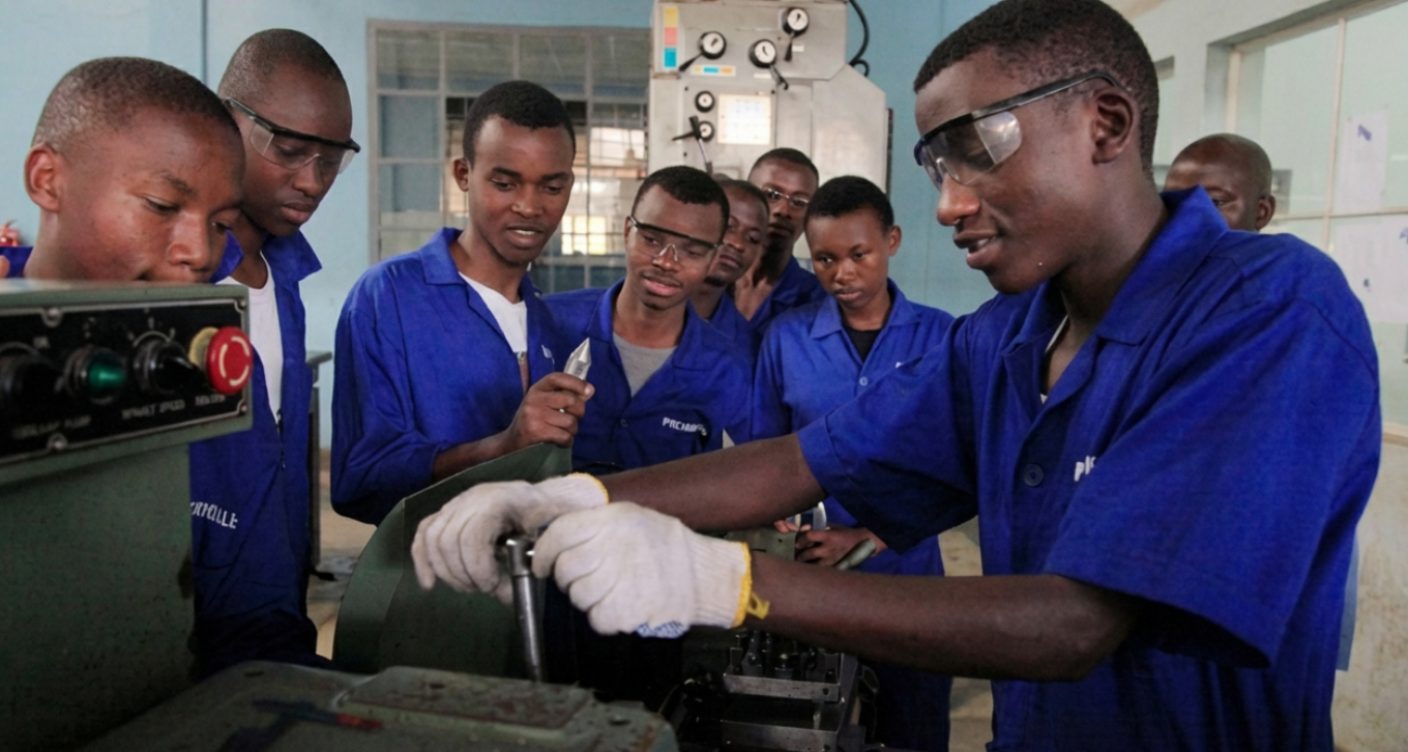
From learning environments into real working environments
Young people need a pathway from training into work, into enterprise and into the practical exposure that builds confidence, discipline, credibility and income.
We began with research.
Before designing AIM-Bridge Africa, AFRDA studied the employment challenge facing young people in Africa, especially youth completing technical and vocational education. We examined the realities behind unemployment, underemployment and stalled enterprise growth, looking closely at why technically trained youth often struggle at the point of transition from school to work.
Structured exposure
Real working environments, not simulations.
Supervised experience
Mentorship that builds credibility.
Business discipline
Management, pricing, cash flow, customers, growth and scaling.
Regional labour space
Pan-African mobility as a strategy.
Then we put the idea to the test
AFRDA did not stop at writing about the problem. We launched a call for candidates and asked applicants to submit motivation letters explaining why they should be considered.
After selection and preparation, AFRDA secured a cross-border placement for one Ugandan agriculture graduate in a seed company in Kenya, finalised in December 2025. The scholar travelled in January 2026 to begin a six-month placement.
This proof of concept moved AIM-Bridge Africa from idea to implementation and allowed AFRDA to test recruitment, selection, placement preparation, host engagement, supervision and follow-up in a real East African setting.

Call for candidates
TVET applicants submitted motivation letters.
Selection & preparation
Cross-border placement secured with a Kenyan seed company.
Departure
The scholar travelled from Uganda to Kenya for a six-month placement.
Live in-host
Active in production, gaining hands-on experience daily.

Already showing what is possible
Today, the first cohort scholar is actively engaged in the host company and gaining hands-on experience in a real production environment. AFRDA is following up consistently, gathering field updates, visual documentation and performance feedback.
The scholar is learning quickly, adapting well, contributing meaningfully and translating classroom knowledge into practical value. The host company has given positive signals about performance and indicated possible retention after the placement period.
It is not a simulation. It is a live, working demonstration.
From one proof of concept to an Africa transition platform
Scale a tested model
Move from one live proof of concept to a structured transition platform serving many young people across Africa.
Connect graduates to host environments
Open quality placements for final-year students and graduates in practical industry settings across African countries.
Strengthen youth-led enterprises
Support technical founders with business readiness, enterprise discipline, mentoring, market access and growth guidance.
Build a repeatable system
Create a credible structure that improves employability, enterprise survival, regional exposure and long-term economic participation.
Africa needs stronger bridges from graduation to work
Support for this initiative is not only support for one cohort of youth. It is support for a model with potential to influence how transition support is designed, delivered and scaled across the continent.
Partner with AFRDA to help opportunity move, and when it does, young people move with it.