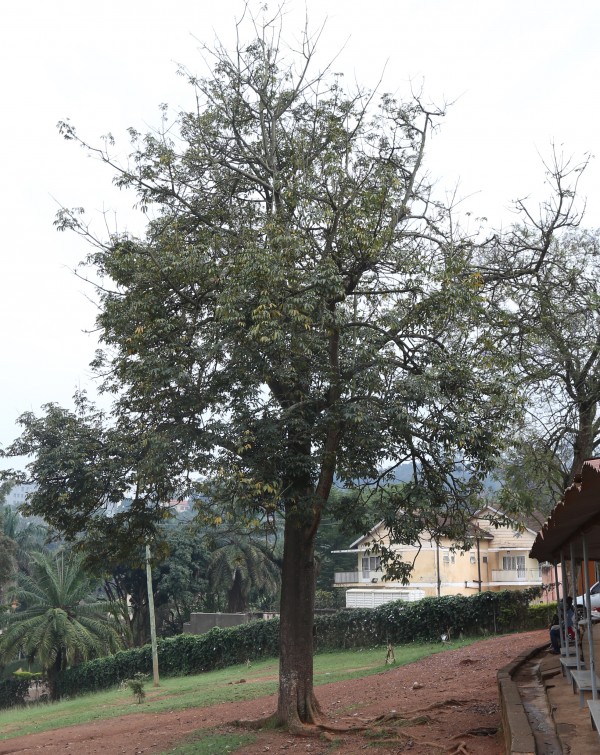
Bombax buonopozense (B. reflexum)
Red silk cotton, wild kapok, wild silk cotton
Kwamba: Kitutube, bulanka Rukonjo: Mulungula Runyoro: Mulimbi.
Description
A deciduous forest tree 45-75 m, the straight bole reaching up to a narrow crown has short buttresses at the base. It can be free of branches for 18 - 24 meters and 60 - 120cm in diameter. The trunk isarmed with large conical woody spines, black-tipped on theyounger branches which are generally whorled.
BARK: smooth, silvery or grey-green becoming rough and scaly, dark and fissured. When cut the bark is deep red, with large lenticels (breathingpores) in vertical lines.
LEAVES: compound digitate with 5-7leaflets , narrow-oval and pointed, variable, about 14 cm (up to 20cm) on a leaf stalk 5-20 cm.
FLOWERS: solitary and bright red , appearing on the bare tree, held erect all along the branches, thegreen calyx saucer-shaped, 5 red petals hairy inside and a centralmass of black stamens.
FRUIT: a 5-part woody capsule to 15 cmlong hangs down on a thick stalk. Inside numerous seeds aresurrounded by grey-white fluffy kapok.
Uses
Seed hairs are useful as packing material for pillows, mattresses.
Edible: young leaves and flowers can be dried or used as a potherb, the fleshy, rather mucilaginous calyces are eaten or used in sauces like the calyx of Hibiscus sabdariffa, young fruits can be cut, dried and then eaten in various meals, the seeds yield an edible oil. http://tropical.theferns.info/viewtropical.php id=Bombax+buonopozense , https://www.prota4u.org/database/protav8.asp g=pe&p=Bombax+buonopozense+P.Beauv
Sheets of bark have been used as roofing material for small huts.
The wood is used for making dug-out canoes, troughs, quivers, stools and domestic appliances. It is also suitable for light construction, light flooring, interior trim, sporting goods, agricultural implements, boxes, modelling, carvings, toys, turnery, insulation, wood wool, plywood, hardboard and particle board.
The spines have been carved into pieces for the game of checkers or other small objects, such as letters, used for embossing.
A reddish-brown dye has been obtained from the bark.
The bark also yields a gum-exudate.
The dried calyx mixed with bark or spines was formerly chewed as a substitute of kola nut or to clean teeth.
Medicine: the bark, flowers and leaves. https://www.prota4u.org/database/protav8.asp g=pe&p=Bombax+buonopozense+P.Beauv
Agroforestry: fresh leaves are a fodder for goats, flowers are an important source of food for honeybees.
An ornamental (avenue) tree.
Ecology
A tree of tropical rain forest extending into West Africa. It occurs in the Semliki, Maramagambo, Bugoma and Budongo Forests of Uganda, in the swamp forests around Lake Victoria and only rarely on drier sites. In Kampala, Red silk cotton can be found along Jinja road, Bombo Road, Upper Kololo terrace, within Kitante Secondary School among other places.
Management
Fast growing.
Tree gallery
.jpg)
.jpg)
.jpg)
.jpg)