Rauvolfia vomitoria
Swizzlestick
Lusoga: Kawule.
Description
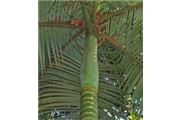
A shrub or small untidy tree to 10 m. Older parts of the plant contain no latex. The branches are whorled and the nodes enlarged and lumpy.
BARK: thin, dark brown or grey-black, when young exuding white latex if cut. Branchlets slender and 4-sided.
LEAVES: in characteristic whorls of 3-4 on the thin branches and well-spaced. Leaves shiny green, about 13 cm long on stalks to 2 cm.
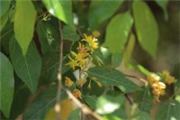
FLOWERS: in branched heads beside leaves, about 7 cm long, the tiny tubular flowers distinctly stalked white-pale yellow, hairy at the mouth.
FRUIT: 1 or 2 together on the branched head, oval, ripening yellow then red, about 8 mm across and containing one large seed.
Uses
Medicine: roots, fruit, leaves, latex, bark, and leaf sap. http://tropical.theferns.info/viewtropical.php id=Rauvolfia+vomitoria
Provides timber which is used to make small kitchen utensils and the heartwood is sometimes used as a substitute for box-wood.
Agroforestry: can be planted as a shade tree for cacao and coffee, can be used as a support for vanilla, can be grown as a live fence, provides bee forage (used in apiculture).
The young twigs with a whorl of branches at the end are used as mixing sticks for drinks. Larger branches are similarly used to stir the indigo mixture in dyeing pits.
A yellow dye is produced from the bark.
The bark and root powder, are mixed with water or palm oil to kill fleas and vermin. The root bark extracts are reportedly poisonous.
Provides fuelwood and charcoal.
A latex exudes from the young stems.
An ornamental tree.
Ecology
Swizzle stick is from Senegal to West Cameroons, and extending across Africa to Egypt, Sudan, Tanganyika, Uganda and Zaïre . Occurs in secondary forest or scrub and on forest edges. Abundant in thickets near Lake Victoria. It is common in Mengo and also Budongo. In Kampala, this tree can be found within Makerere University zone 7 among other places.
Management
Fast growing. Coppicing, pollarding.
Tree gallery

.jpg)
.jpg)
.jpg)
.jpg)