Ravenala madagascariensis
Traveller's tree or Traveller's palm
Description
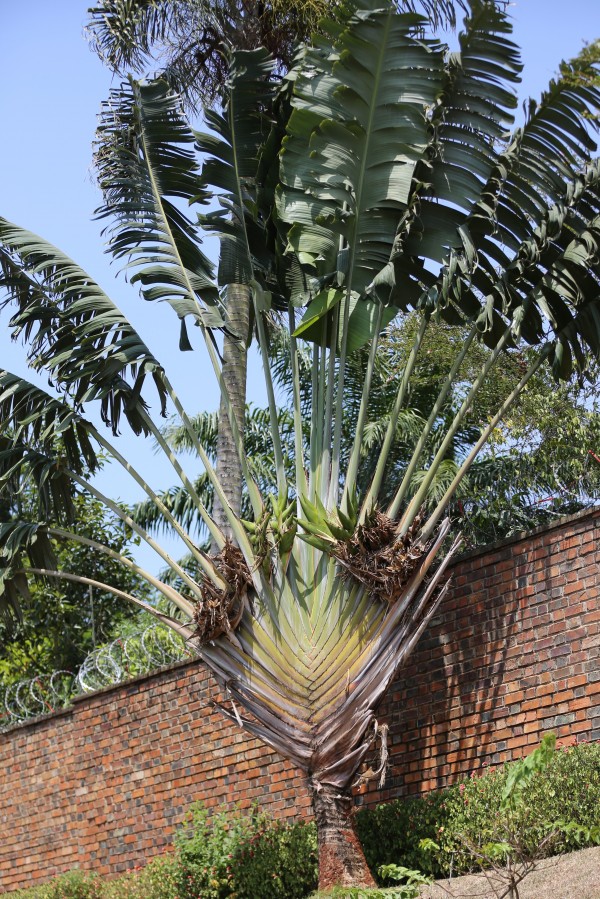
Traveller's tree is an evergreen tree with an open, fan-like crown; it usually grows up to 20 meters tall, though specimens up to 30 meters have been reported. The trunk can attain a diameter of 2 feet (60 cm). In early years, the trunk of this plant is subterranean (not visible), with the fan of leaves sitting on the ground. Eventually the trunk does appear and lengthen, with somewhat attractive leaf scar rings forming on the trunk surface as the lower leaves drop. As the plant grows older, it progressively loses the lowest or oldest leaves and reveals a sturdy grey trunk.
BARK: solitary or branched at base, cylindrical, woody, ring-scarred, olive green and smooth or grey and fissured, apical third clothed by leaf bases. It has characteristic leaf-scar rings hidden underground in juvenile plants, and emergent in mature plants.
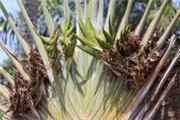
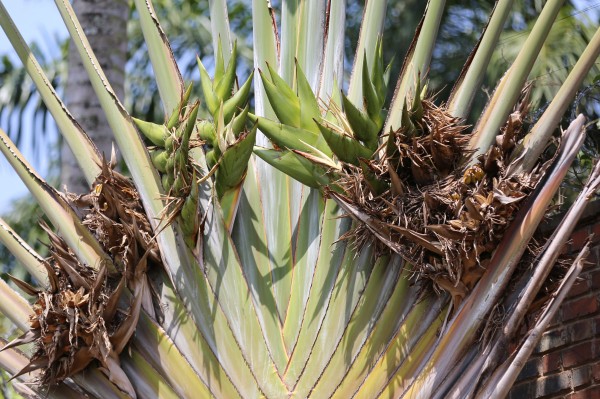
LEAVES: crown fan-like, with 20 or more leaves. Leaves alternate, distichously arranged, simple; petiole 3–6 m long, stout, channelled, with air canals, arising at 45° to axis, base cup-shaped, broadly sheathing and overlapping; blade oblong, 2.5–4(–5) m × 0.8–1.5 m, base and apex rounded, entire but often torn at the veins, glabrous, dull green, midrib sulcate, pale, with closely set, parallel veins.
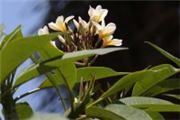
FLOWERS: Inflorescence an axillary thyrse, bearing cincinnate flower clusters enclosed in distichously arranged, large, stiff, boat-shaped bracts 20–25(–30) cm long, whitish. Flowers bisexual, slightly zygomorphic, 3-merous, subtended by carinate bracteoles, all flower parts creamy white; sepals free, lanceolate, sub-equal, up to 20 cm long, long-acuminate; petals free, lanceolate, up to 15 cm long, posterior one shorter than other 2; nectaries with copious nectar; stamens 6 in 2 whorls of 3, up to 16 cm long, anthers basifixed, dehiscing via longitudinal slits; ovary inferior, 3-locular, style long, straight, stigma with finger-like protuberances.
FRUIT: brown, oblong, woody, 3-lobed capsules2–4 cm long.Seeds are numerous,black, thinly covered with glossy blue and hairy aril.
Uses
Ornamental palm.
Edible: seed, fruit, seed oil can be used for cooking, sugar can be extracted from the sap of the trunk, copious amounts of rainwater that collect in the leaf bases and leaf bracts are used as refreshment by thirsty travelers. http://tropical.theferns.info/viewtropical.php id=Ravenala+madagascariensis
Medicine: the seed oil. http://tropical.theferns.info/viewtropical.php id=Ravenala+madagascariensis
Leaves are used for roofing and as a packing material.
Leaf petioles and midribs are used for making walls.
Bark is used for making floors in houses.
The stem is used in house construction.
Agroforestry: the pith from the trunk is sometimes used as a fodder for livestock.
Ecology
Ravenala madagascariensis is native to moist forests in Madagascar. It has now been planted in frost free areas around the world, including far southern Florida into the Keys, southern Texas, southern California and Hawaii. In tropical and subtropical regions, the plant is widely planted as an ornamental tree. It prefers a sub-tropical or monsoonal climate zone. It is mostly found in rainforest sheltered, warm and humid, and per-humid areas near the coast, from sea-level up to elevations of 450 meters, but it can also be found up to 1,000 meters. In Kampala, this palm can be found within Kitante courts, along Old Kira Road, Windsor Loop road among other places.
Management
The seeds are slow to germinate and rooted suckers can be separated at the beginning of the rainy season, and are planted directly into fertile soil for quick growth. Traveller's tree is cultivated in landscapes for its tropical looking and architectural crown, if neat formal appearance is desired, remove basal suckers regularly to maintain clear trunked specimens, and prune away older leaves. They can be grown in containers to constrain size, avoid planting in areas with strong winds, which may result in torn tattered leaves.
Tree gallery
.jpg)
.jpg)
.jpg)