Sterculia dawei
Kwamba: Kitokwe, kitomo Lugwe: Muhanga Lusoga: Musandasanda
Description
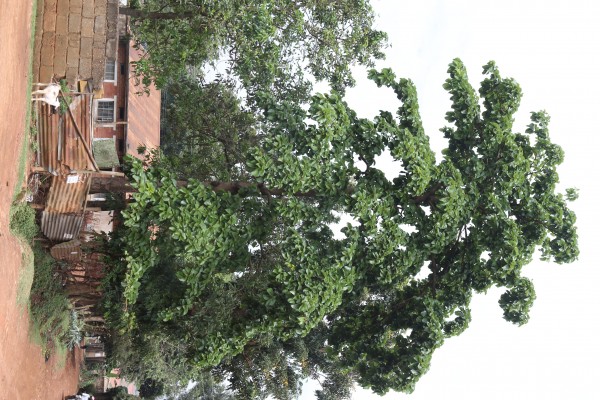
A tall deciduous forest tree with a long cylindrical bole, 9-30 m to a fairly small crown. Buttresses generally absent.
BARK: quite thin, brown to grey-brown, moderately rough with small vertical and horizontal marks, flaking in small pieces. Branchlets thick, red-brown, very fibrous.
LEAVES: unlobed, broadly oblong-oval, 9-18 cm long, base rounded to heart-shaped but lobes hardly overlap, more than 3 veins from the base not extending more than half way along the leaf, 7-11 lateral veins, tip protruding but rounded or shortly pointed, stalk to 7 cm, both surfaces slightly hairy at first (hairs star-shaped), older leaves just hairy below.
FLOWERS: very small, on long hairy branched stalks beside upper leaves, each flower with a small hairy calyx cup (no petals), green outside, purple-red inside.
FRUIT: woody, often in threes, boat-shaped and beaked 5-10 cm long, softly hairy, green then bright red when ripe (no aril), fading brown, opening to release black seeds to 2 cm long. Pale brown hairs line the inside of the fruit.
Uses
Provides firewood and charcoal.
Agroforestry: provides shade (for coffee, banana, cocoa plantations).
The fibres from bark are used for making string and ropes.
An ornamental tree (avenue).
Ecology
Native to Uganda. A tree of mixed tropical rain forest. It is widespread in Uganda; common in the Lake Victoria forest belt and in Bundibugyo District. It grows in Kasyoha-Kitumi forest but not in Kigezi or Ankole. In Kampala, this tree can be found in Makerere II Zone C among other places.
Management
Coppicing, pollarding
Tree gallery
.jpg)
.jpg)
.jpg)
.jpg)