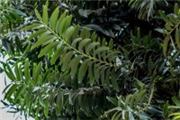
Agathis atropurpurea
Queensland Kauri Pine, Black Kauri, Blue Kauri, Kauri, Black, Blue, Mountain, North Queensland, Mountain Kauri, North Queensland Kauri, Pine
Description
Black kauri is an evergreen coniferous tree. When allowed to grow into a large tree, it can reach heights of 165 feet (50 m) tall.
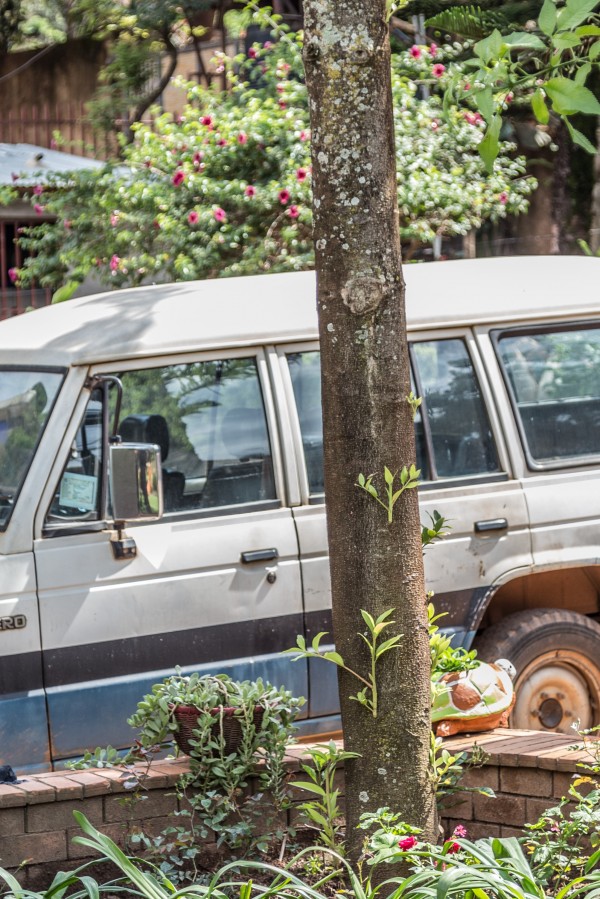
BARK: blue, purple or almost black except on large trees where it is brown. However, even on large trees some blue or black coloration is usually evident. Smaller trees have a distinctive black, purple or navy blue bark, which is smoother and only slightly flaky.
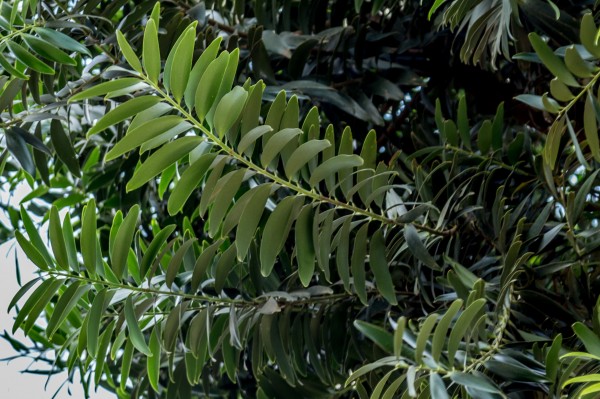
LEAVES: lanceolate, 1.5 to 1.75 inches long and 0.32 to 0.55 inches wide closely set, glaucous beneath, with a bluntly notched apex, a pointed tip and fine longitudinal veins.
FLOWERS: Male cones less than 3 cm long, distinctly pendunculate. Scales are slightly rounded at the apex and tending to overlap.
FRUITS: Cones usually less than 6 cm each with about 90-150 scales.
Uses
Traditionally, it has been used as a fuel for camp fires, as a torch, as a waterproofing on boats, as a medicine, the smoke from the burning resin is used as a black dye and for tattooing.
The resin is used commercially in making high quality varnishes, lacquers, linoleum.
The tree has valuable timber tree, producing a durable, fine-grained, featureless timber. It is used for various interior purposes such as high-class furniture, veneer, boxes and crates, light carpentry, musical instruments, molding, sliced veneer, joinery, paneling, matches, wood-ware.
Ecology
This species is endemic to the coastal ranges of North East Queensland. It is typically found growing in rain forests on mountain ridges composed of igneous rocks such as granite and rhyolite at elevations of 2,460 to 4,900 feet (750 -1,500 m) above sea level. It is an emergent tree, restricted to simple microphyll vine-fern forest in cloudy wet highlands; at elevations from 700 - 1,600 meters. Young plants grow better in the shelter and shade of the woodland, but require increasing amounts of light, as they grow larger.
Tree gallery
.jpg)