Callistemon citrinus var. splendens
Bottlebrush scarlet, Bottlebrush, Lemon bottlebrush or Red bottlebrush, Crimson Bottlebrush
Description
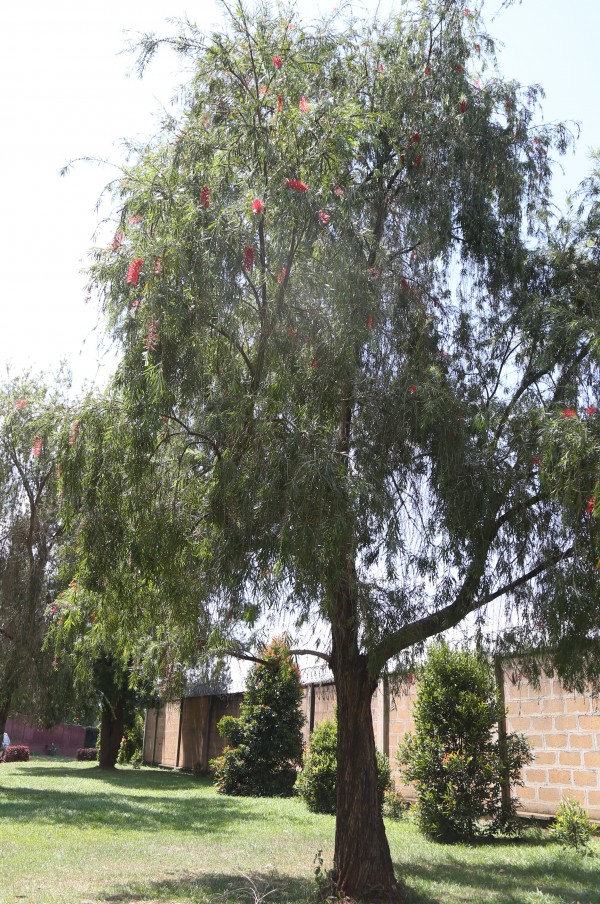
A small evergreen tree, to 6 m high, with drooping foliage.
BARK: grey, smooth, furrowed with age.
LEAVES: narrow, tough, grey-green to 8 cm, young leaves pink-green, faintly lemon scented when crushed.
FLOWERS: vivid crimson bottlebrush- like cylindrical spikes, a mass of long red stamens , nectarattracting sunbirds and bees. Leafy shoots continue to growbeyond the flower "brush".
FRUIT: small woody capsules , persisting many months, contain the tiny seed.
Uses
Agroforestry: can be used to make a large hedge and can act as a wind break, provides bee forage.
Tan dye can be obtained from the flowers. http://tropical.theferns.info/viewtropical.php id=Callistemon+citrinus
Cinnamon dye can be obtained from the leaves. http://tropical.theferns.info/viewtropical.php id=Callistemon+citrinus
Wood can be used to make tool handles.
It provides firewood.
An ornamental (avenue tree).
Medicine: the bark and leaves.
Edible: leaves are a tea substitute and have a delightfully refreshing flavor.
Ecology
In Australia it is found on low-lying ground including valley bottoms, so will grow on badly drained sites. It's now widely planted in the tropics and common in Central and Western Regions of Uganda. In Kampala, bottle brush is found within Africa hall premises, along Kololo hill lane, within Tuffnel village among others.
Management
Fast growing on good sites. Plants are very tolerant of pruning; even old plants will regenerate if pruned back hard into the old wood.
Tree gallery
.jpg)
.jpg)
.jpg)
.jpg)