Canarium schweinfurthii
Incense tree, purple canary tree, African elemi, Gum resin tree
Kwamba: Buhura, byoro Luganda: Muwafu Lusoga: Mubafu Rukiga: Mubani, nyegye Runyankore: Mubani Runyoro:Mubani, musanki Rutoro:Mubani.
Description
African elemi is a large, evergreen forest tree with its crown reaching to the upper canopy of the forest, with a long clean, straight and cylindrical bole that can exceed 50 meters. Large branches reach to a spreading rounded umbrella crown. In young trees branches are whorled, at right angles to the trunk and curve upwards. The base may have slight blunt buttresses and overground roots may spread out to 10 m from the tree base.
BARK: thick and rough, grey-red-brown, flaking in pieces up to 30 by 10 cm. Young branchlets hairy red-brown. When cut the fragrant resin smells of incense.
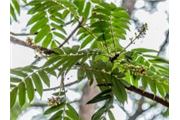
LEAVES: odd pinnate tufted at the ends of branches, usually 6-10 pairs of leaflets plus 1, each with a short stalk, oval to oblong, stiff, long pointed to 15 cm, base rounded, about 15 pairs side veins, vein network dense below, surface dull green-brown with a few hairs but more hairy below, especially on veins.
FLOWERS: cream white in axillary sprays to 30 cm long, 3 petals and a 3-part calyx, funnel shaped with rust-red hairs inside and out.
FRUIT: smooth and oblong, soft and purple when ripe, 2.5-4.0 cm long. A 3-ridged stone inside as long as the fruit, eventually splits to release 3 seeds.
Uses
Edible: fruit is oily, eaten and often used as a condiment, the seed-kernel is sometimes prepared into a vegetable-butter and eaten as a substitute for shea-butter.
Medicine: the resin, bark, leaves, roots, seeds. http://tropical.theferns.info/viewtropical.php id=canarium+schweinfurthii
The resin is also used to repair broken pottery, for caulking boats and as a gum for fastening arrowheads to shafts.
The resin contains 8-20 % of an essential oil, the main constituent of which is limonene.
The resin is used as a fumigant against mosquitoes.
Agroforestry: provides shade and has potential as a wind break, can be planted for reforestation.
The endocarp is used by children as spinning tops.
The seeds are strung into necklaces or attached to traditional instruments.
The bark of young trees is split off in Gabon to make boxes.
The wood is said to secrete oil and is used for canoe making.
Provides timber which is used as core veneer, for decorative panelling, parquetry, furniture, flooring and for general utility purposes.
Provides good fuel and charcoal.
An ornamental (avenue tree).
Ecology
African elemi is native to tropical Africa. One of only two African species, this large tree is widely distributed in Senegal, Sudan, south-west Ethiopia, Tanzania to Angola and Zambia. In Uganda, it is common in Kalinza Forest Reserve, and in the forests around Lake Victoria and Kampala city. Often an isolated tree in cleared land, especially in Jinja, Kamuli and Iganga Districts, rare in Ankole and Kigezi. Rainfall 900-1,400 m. In Kampala, purple canary tree is located along Kamwokya- kyebando road, along Sezibwa road, upper Kololo terrace, within zone C private residences among other places.
Management
Slow
growing.
Tree gallery
.jpg)