Euphorbia tirucalli
Finger euphorbia, African milkbush, Pencil plant, Rubber-hedge euphorbia
Luganda: Nkoni Lugwe: Nkoni Lunyuli: Luhoni Luo A: Kilajok Luo L: Oligo Lusoga: Lukone Rukiga: Nkoni Runyankore: Nkoni, ruyenzhe Runyoro: Rukoni Rutoro: Nkoni.
Description
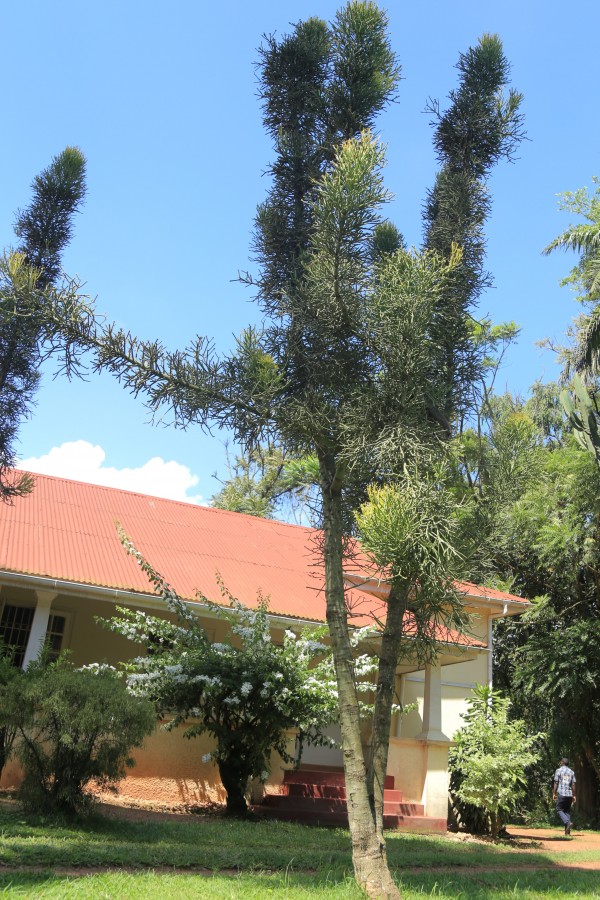
A dense straight-stemmed tree to 6 m or more, the branchlets smooth green, cylindrical in dense masses.
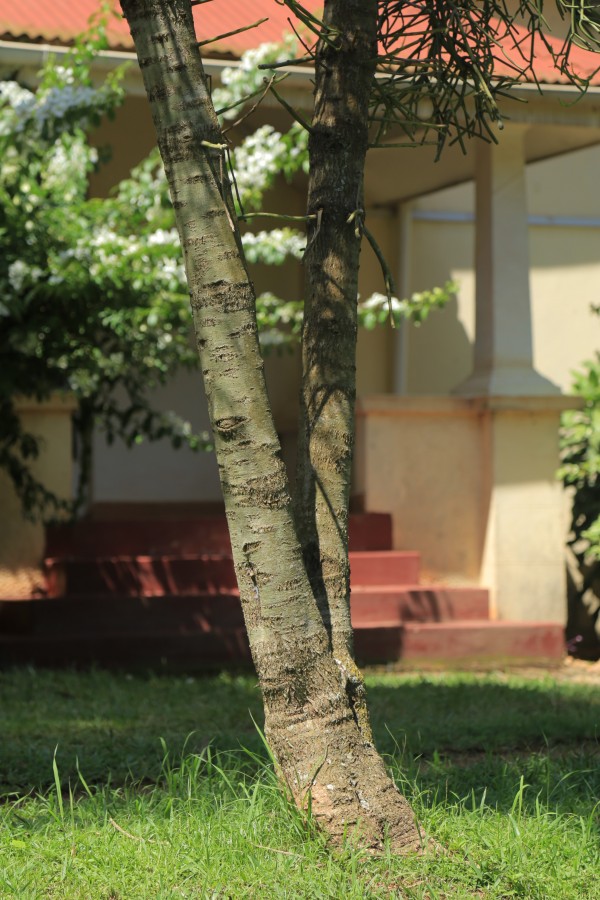
BARK: very old specimens is grey and rough with longitudinal dents and ridges that break up into very small fragments. There are sometimes conspicuous, small protuberances, such as bulges, knobs, or swellings, on the bark, and occasionally black, rough, cross wise bands.
LEAVES: small, present on young stems, soon dropping.
FLOWERS: yellow-cream, small in dense clusters.
FRUIT: 3-part capsules, hard, purple-green, less than 1 cm across.
Uses
Medicine: latex, roots, buds, stems, young branches, leaves, and wood. http://tropical.theferns.info/viewtropical.php id=Euphorbia+tirucalli , https://pubs.acs.org/doi/pdf/10.1021/bk-2013-1127.ch001
It’s an ornamental tree.
The latex is piscicidal and insecticidal. The plant is also used as an effective repellent for mosquitoes and ants.
Agroforestry: planted to protect sand dunes and bare soil in dry areas from wind and water erosion, effective plant for land reclamation programmes, used hedge plant, boundary demarcation, live fencing around compounds and kraals, and as a windbreak in semi-arid areas.
The sap evidently has strong fixative power: mixed with animal hair it is used for fastening knife-blades to wood handles and spear-heads to shafts.
The biomass can be converted into gas, liquid fuels and solid fuels such as pellets, briquettes and charcoal.
The resin can be used in varnishes for certain purposes in the absence of better materials.
An oil obtained from the latex was formerly used in linoleum, oilskin, and leather cloth industries.
Methane can be produced by anaerobic fermentation of the latex.
The wood is used for toys, rafters and veneers.
The wood is used for fuel and it gives a charcoal suitable for gun-powder, and for the manufacture of fireworks.
The tree can be used for manufacturing rubber substitutes.
The tree is used in cultural connotations e.g. as a sign of starting a new home in Luo culture of East Africa
The latex is also reported to be a hunter's tool applied in local fishing and arrow poisoning in tropical Africa.
Ecology
A tree of uncertain origin commonly planted in the tropics and subtropics of Asia and Africa. Much associated with human habitation and frequently planted as a live fence.
Management
Fast growing; coppicing, trimming and top pruning to make a fence.
Tree gallery
.jpg)
.jpg)