
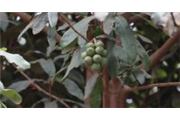
Macadamia tetraphylla
Queensland nut, Rough-shelled bush Nut, Macadamia nut
Description
A small to medium sized, densely branched tree, up to 18 m with a diameter of 45 cm.
BARK: greyish-brown, smooth or finely wrinkled, with numerous cream horizontal lenticels. Branchlets brown to greyish-brown, young shoots hairy.
LEAVES: in whorls of 4, simple, the margins always pricky-toothed with 33- 40 teeth on each side, oblong or oblong lanceolate, 7-25 cm long, 2-5 cm wide, abruptly rounded to a short sharp point at the tip, rigid in texture.
FLOWERS: Inflorescence axillary or on the branches, 10-25 cm long; flowers creamy pink to mauve, 10 mm long.
FRUIT: 20-35 mm in diameter, greyish-green, turning brown.
Uses
Edible: Seeds can be eaten raw or, can also be ground into flour and then mixed with cereal flours to enrich the protein content.
Agroforestry: the decomposed husk is commonly used in potting soil.
The green seed hulls contain approximately 14% of tannins.
The oil from the seed is used in cosmetics.
Macadamia shells may be used as fuel, generating sufficient energy to dry wet, in-shell nuts.
The tree is used as a rootstock for M. Integrifolia .
Ecology
Queensland nut is native to Australia. It is mainly found on alluvial situations bordering rivers and creeks where the fertile volcanic soils are rich in humus.
Management
Slow growing.
Pruning, weed control and fertilizer application.
Tree gallery
.jpg)
.jpg)
.jpg)


