Pinus caribaea
Caribbean pine,Cuban pine, pitch pine, slash pine
Description
An evergreen tree with a straight bole and regular spreading crown up to 30 m high. The bole can reach over 1 m in diameter.
BARK: thick, brown-grey, rough and flaking, resinous if cut.
LEAVES: needles, usually in threes, erect, flexible, dark green up to 21 cm long, usually less sharp pointed.
FLOWERS: male and female flowers produced separately on the same tree. Male flowers on the upper part of branchlets, female on the lower part.
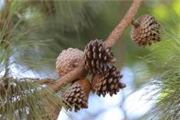
FRUIT: cones, greyish brown at maturity, about 8 cm long, each cone with a prominent spine.
Uses
Edible: vanillin flavouring is obtained as a by-product of other resins that are released from the pulpwood. http://tropical.theferns.info/viewtropical.php id=Pinus+caribaea
Agroforestry: the mat of needles on the ground is considered valuable for the protection of the soil surface from erosion, used to clothe barren eroded and denuded lands with a tree cover, grown to provide shelter from the wind.
Medicine: leaf oil, resin, and the bark. http://tropical.theferns.info/viewtropical.php id=Pinus+caribaea
The sapwood can be tapped for oleoresin. It yields turpentine and gum rosin during distillation which are used in paint and batik industries, and in the production of paper, soap and glue respectively.
The bark contains tannin; about 10% can be extracted and dried to a reddish powder soluble in water.
The tree can be used for fuel wood and also make charcoal.
Provides timber which can be used for shuttering, temporary applications and packaging, and it is useful for turnery, toys, moulding and other novelty items. It is also suitable for interior trim, veneer, plywood, piles, vats, particle board and fiberboard.
The presence of long tracheids makes this species a good source of wood pulp. The wood pulp is also used for the manufacture of particleboard, fiberboard and chipboard.
Ecology
In its natural range it grows at low elevations and has now become an important commercial plantation tree in many tropical lowlands below 1,000 m. In Uganda, it is widely cultivated in moist lowlands and planted as an ornamental. The tree does better on free-draining soils and is drought resistant. In Kampala, Pinus caribaea can be found within Makerere university, Uganda Golf course club, along Lower Kololo terrace, Upper Mawanda road among other places.
Management
Fast growing; pruning, fire protection.
Tree gallery
.jpg)
.jpg)
.jpg)
.jpg)
.jpg)