Psidium guajava
Guava
Luganda: Mupeera.
Description
A small evergreen tree to 8 m, branching irregularly.
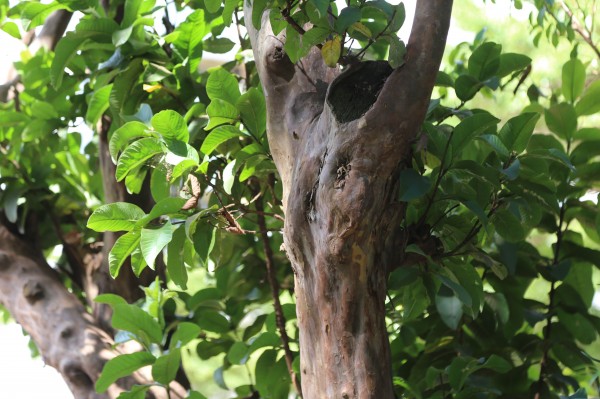
BARK: smooth, pale brown, later peeling and flaking; young shoots 4sided.
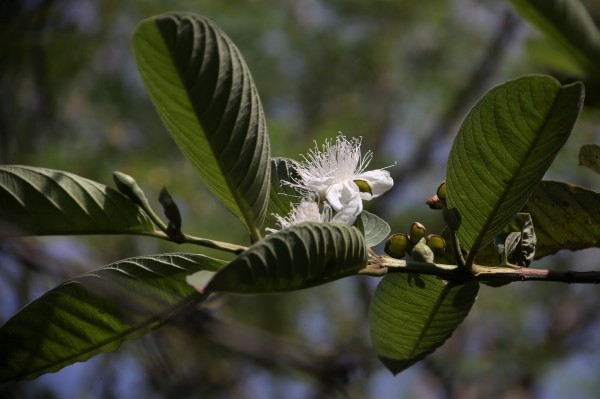
LEAVES: large, dull and oval to 15 cm long, side veins prominently hairy below, in opposite pairs.
FLOWERS: white, about 2.5 cm across, 1-3 together beside leaves, many stamens.
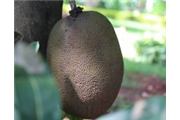
FRUIT: rounded to 6 cm long, tipped by remains of calyx, pink, white, or yellow, depending on the variety. The sweet flesh surrounds many hard angular seeds.
Uses
Edible: whole fruit is eaten, fruit makes a very nice jam and can also be pureed then added to a range of desserts, edible oil is obtained from the seeds. http://tropical.theferns.info/viewtropical.php id=Psidium+guajava
Agroforestry: can be used in apiculture, can be used as a support tree (has been used to stake yams ( Dioscorea spp. ), can be used in intercropping.
Wood makes excellent firewood and charcoal.
Provides timber which is used for tool handle, fence posts and in carpentry and turnery.
The leaves and bark may be used for dyeing and tanning.
The leaves are pounded with coconut milk and other substances to make a dye that turns silk black.
The leaves are the source of an essential oil that contains methylchavicol, persein and d-pinene.
The fruit can be used in making alcohol. Wine making from the fruit has been commercialized in southern Africa.
P. guajava has insecticidal properties.
Medicine: Fruits, the leaves, and the bark. http://www.worldagroforestry.org/treedb/AFTPDFS/Psidium_guajava.PDF
An ornamental tree.
The tree is used as pollution controller. Its identified as useful for bio-indication and as a bio-accumulator in India. It is sensitive to sulphur dioxide; sensitivity to injury based on chlorophyll destruction. http://www.worldagroforestry.org/treedb/AFTPDFS/Psidium_guajava.PDF
Ecology
This tree originates from South America, probably Brazil, but is now grown throughout the tropics, including Africa south of the Sahara. In Uganda, it is grown in all Regions of the country including North Eastern Region where it occurs near water around Mt. Kadam. It is a moisture-loving species, requiring rainfall of 1,000-2,000 mm. It is drought resistant but cannot tolerate waterlogging. It grows at a wide range of altitudes in Uganda. In Kampala, Guava tree can be found within Uganda Golf course club, KCCA headquarters, along Elizabeth avenue, Impala avenue among other places.
Management
Fast growing; pollarding, lopping, pruning, coppicing. Prune branches and roots if near crops.
Tree gallery
.jpg)
.jpg)
.jpg)