Syzygium owariense
Water berry
Description
A semi-deciduous multi-stemmed shrub or small tree up to 8 m, erect branches to a bushy rounded crown.
BARK: grey, thick, smooth at first becoming dark grey, rough and flaking with age.
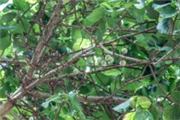
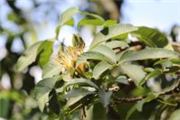
LEAVES : opposite, blue-green, thick, leathery, smooth and shiny, about 10 cm long, leaf tip long pointed but blunt, pink-yellow midrib, clear below, leaf stalk pink-red, aromatic when crushed.
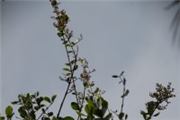
FLOWERS: creamy white or pink with numerous stamens, sweet scented, in heads to 15 cm across, on angular square stalks.
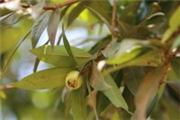
FRUIT: oblong and fleshy, about 1.5 cm long and 1 cm thick, green at first, purple then black when ripe, containing 1 seed.
Uses
A purple dye is obtained from the fruits.
The wood is used to make spoons.
The wood is used for fuel.
Edible: leaves and the fruit contain the essential oil eugenol, which has been used for flavouring food, fruit is eaten.
Agroforestry: provides bee forage.
Ecology
Water berry is indigenous to Uganda. A tree of swamp forests, stream banks, riverine thicket and woodland along streams at higher altitudes from South Africa, Malawi, Zambia and Mozambique and into West Africa. In Uganda, it grows in wooded grassland and semi-arid woodland preferring stony ground and hills. It is common in Mt. Kei and Otze Forest Reserves. In Kapchorwa District, it is sometimes associated with Syzygium cordatum and Flacourtia indica . In Kampala, this tree can found within Makerere University around Nkurumah hall.
Management
Coppicing, pollarding.
Tree gallery
.jpg)
.jpg)
.jpg)
.jpg)