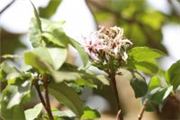
Calodendrum capense
Cape chestnut, wild chestnut
Description
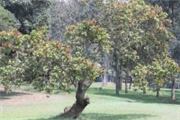
Cape chestnut is a semi-deciduous tree to 20 m with a rounded, dense canopy, and a shapely spreading crown, bare for several months. Forest grown trees tend to have straight stems, sometimes buttressed; but in hot dry valleys the plants are low, gnarled, with small leaves and flowers
BARK: grey, smooth, young branchlets hairy, buttressed and lichen-covered in older specimens.
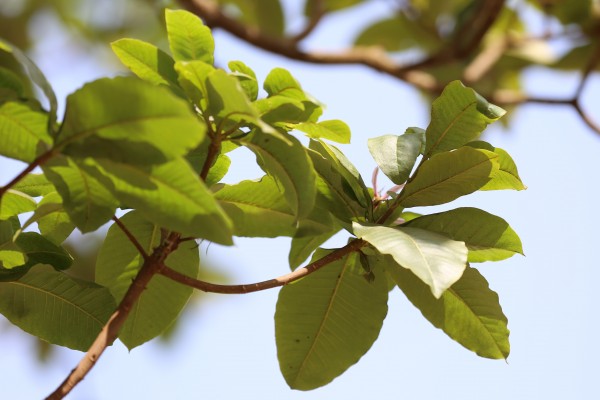
LEAVES: dark green, opposite, simple, often bunched together, broadlyoval and wavy to 14 cm, midrib and veins very clear underneath.
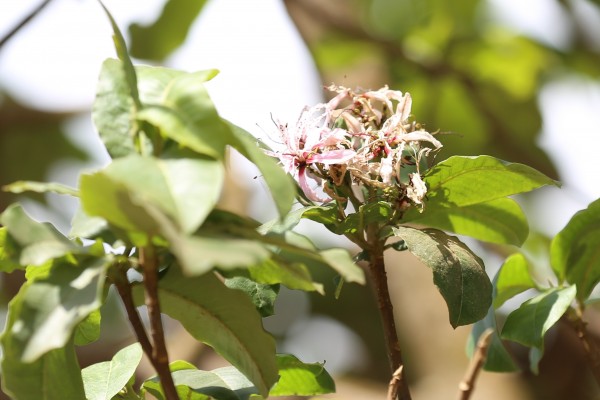
FLOWERS: large and showy, pink-white in erect heads, abundantbut erratic, at the ends of branches, crimson gland dots, purple-brown anthers on the long stamens.
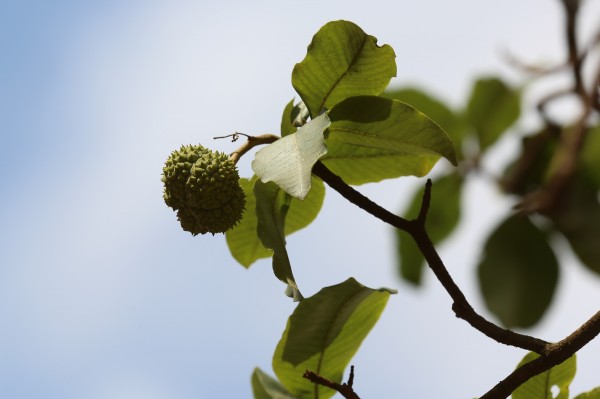
FRUIT: green maturing to brown, knobbly tosoftly spiny becoming hard , capsules ("chestnut") hang on thetree then set free black angular seeds.
Uses
Medicine: the oil from the seed. http://www.tropical.theferns.info/viewtropical.php id=Calodendrum+capense
Agroforestry: the leaf-fall is very heavy so trees provide mulch, the trees provide valuable shade and can be used as windbreaks, and provides good bee forage).
The kernel yields a lemon-yellow, rather bitter, non-drying oil that can be used for making soap. http://pza.sanbi.org/calodendrum-capense
The oil also has a high potential for use as lubricant and as fuel in diesel engines.
The bark is used in cosmetics to dye the skin a whitish colour. http://www.tropical.theferns.info/viewtropical.php id=Calodendrum+capense
The wood provides timber which is used for making tent bows, wagon making, yokes, planking, shovel handles and furniture.
The tree provides poles.
The wood provides firewood and charcoal.
An ornamental (avenue tree). It is suitable for street and parking lot planting.
Provides shade to the people.
Ecology
Calodendrum capense is a beautiful tree from the Cape. This tree is widespread in Africa from Uganda to southern Africa. It is a plant of the tropics and sub tropics, succeeding at altitudes from sea level to 2,200 meters. It grows best in areas where annual daytime temperatures are within the range 20 - 30 c, but can tolerate 15 - 45 c. C. capense can be found growing in wooded ravines, in evergreen fringe forest, at the coast, sometimes in scrub. In Uganda it occurs only rarely in scattered patches of woodland in Mbarara District. It has, however, also been planted as a beautiful garden and avenue tree in Kampala. The seeds are eaten by birds and monkeys. In Kampala, Calodendrum capense is found along Lumumba avenue, within Makerere University among other places.
Management
Slow growing in most conditions; coppices while young, pollarding. Trees grown from seed will flower after 6 - 7 years, and those grown from cuttings after 4 years. Not good for intercropping due to heavy shade when in leaf, but might be of value in banana plantations.
Tree gallery