Anacardium occidentale
Cashew, Cashew nut
Description
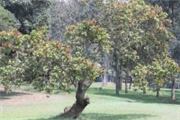
A tree to about 10 m with a dense crown, but usually smaller.
BARK: rough dark brown.
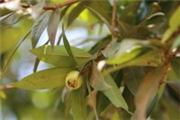
LEAVES: simple, alternate, leathery dark green, oval, 15 cm long, 8 cm wide, rounded tip, wavy.
FLOWERS : in terminal clusters, small and star like, pink-cream coloured, fragrant.
FRUIT: hard, kidney-shaped nuts attached to the base of shiny orange yellow "cashew apple" or "bibo" (swollen flower stalk). Nuts fall to the ground when ripe.
Uses
Edible: fruit, refreshing juice from the fruit, seeds, an edible oil from the seed, young leaves and shoots, cashew wine (slightly fermented juice) can be distilled to produce strong alcoholic drinks. http://tropical.theferns.info/viewtropical.php id=Anacardium+occidentale
Medicine: leaves, bark, fruits, sap, the gum, roots, buds, and seeds . http://tropical.theferns.info/viewtropical.php id=Anacardium+occidentale , http://www.worldagroforestry.org/treedb/AFTPDFS/Anacardium_occidentale.PDF .
Agroforestry: can be planted for erosion control, can be intercropped with cowpeas, groundnuts and horsegram, often used as a support for growing cultivated vanilla, provides fodder (the cake remaining after oil has been extracted from the kernel serves as animal food, seed coats are used as poultry feed).
The stem yields an amber-colored gum which is used as an adhesive (for woodwork panels, plywood, bookbinding) and used in inks, dyes and varnishes.
The fruit is an excellent lubricant and is also used in varnishes, inks, termite proofing wood, insulating coatings etc.
The acrid sap of the bark contains 3-5% tannin and is employed in the tanning industry.
The bark contains an acrid sap of thick brown resin which is used as indelible ink in marking and printing linens and cottons and used as a varnish, a preservative for fishnets and a flux for solder metals.
One of the components of the bark gum acts as a vesicant and has insect repellent properties.
The toxic, acrid oil in the shell is used as a waterproofing agent and preservative, can be used for treating fishing nets, woodwork etc. in order to repel termites, and can also be added to paraffin to make it more effective in controlling mosquito larvae. It can also be used in the manufacture of plastics, and certain sorts of paints such as are used for ship's keels, cement surfaces and where corrosive influences preclude the use of ordinary paint.
The oil is also used in insulating varnishes and in the manufacture of typewriter rolls, oil- and acid-proof cements and tiles, friction-modifying material for brake linings, as a component of space-rocket lubricants, inks, etc.
The wood is used for construction and general carpentry.
Pulp from the wood is used to fabricate corrugated and hardboard boxes.
The wood makes a good charcoal and fuel. The residue of the shell is also used as fuel in cashew nut shell liquid extraction plants.
An ornamental tree.
Ecology
Cashew nut is native to Brazil. A tree introduced to most parts of the tropics as an important cash crop grown in plantations. In Uganda, the species has been introduced in trials in Masindi, Soroti, and Kumi Districts. It has also been planted with crops like coffee and banana or as a shade tree in the drier districts of Uganda. It can be intercropped with vegetables. The tree may be part of a mixed orchard with mangoes, bananas, coconuts and citrus. In Kampala, Cashew nut can be found at Uganda Golf course club among other places.
Management
Slow growing; lopping, coppicing. Anacardium occidentale is rarely pruned. Removal of dead and diseased branches is necessary
Tree gallery
.jpg)
.jpg)
.jpg)