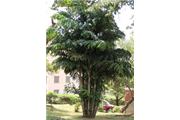
Caryota mitis
Burmese Fishtail palm, clumping fishtail palm, clustered fishtail palm, clustering fishtail palm, fish tail palm, fishtail palm, lesser fish tail palm, tufted fishtail palm, wine palm
Description
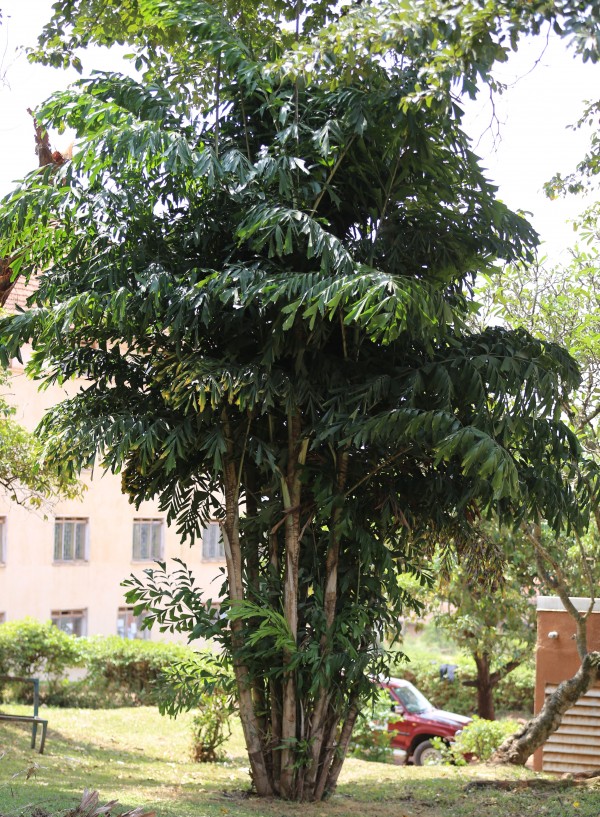
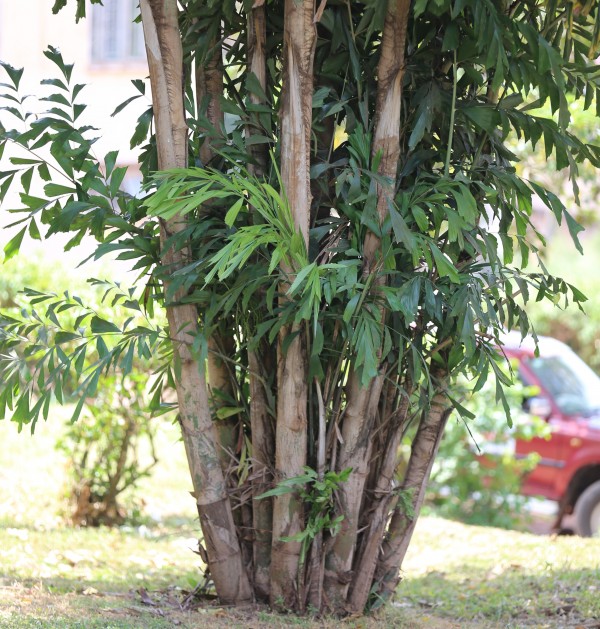
Burmese fishtail palm is a multi-stemmed, clustering, evergreen palm tree growing around 8 meters tall and 4 meters across at the top. The unbranched stems are about 15cm in diameter. Each trunk produces flowers for several seasons, starting from the top of the trunk and moving downwards, but then dies after its final seeding.
BARK: light green/grayish color with quite widely spaced leaf nodes.
LEAVES: light green, bi-pinnate, and triangular, closely resembling a fishes tail in shape. The leaves don't absciss when spent, but they are easily removed due to the palms size.
FLOWERS: pale cream.
FRUIT: Fleshy, oval, reddish-orange, 10 - 20mm (3/8 - 3/4in) long.
Uses
Edible: very young, unfolded leaves are eaten as a vegetable, starch obtained from the trunk is used as sago, seeds can be used as a masticatory in place of betel nut (Areca catechu), seed is eaten after removing the poisonous fruit, sap from the inflorescences is tapped and used for making sugar, alcoholic beverages etc. http://tropical.theferns.info/viewtropical.php id=Caryota+mitis
A fiber is obtained from the leaf petioles.
The leaf sheath fiber is often harvested as a source of thatch, cordage, and to make brushes and brooms.
The woolly hairs on the leaf sheaths, petioles and rachis can be used as tinder or as wadding. They can also be used to caulk wooden boats.
The finer fiber can also be spun into fishing lines or coarse threads for sewing.
Ecology
Burmese Fishtail palm is native to India and south-eastern Asia (i.e. Burma, Malaysia, Indonesia and the Philippines). It grows in Valley forests and Tropical rainforests. In Kampala, this palm can be found within Africa hall premises in Makerere University, along Kyadondo road among other places.
Management
Do not prune palm trees unless an old branch dies. Palm trees grow from the tip of the branch. If you prune or pinch off the newest frond where it is attached to the stem, it will stop all new growth. Water thoroughly then allow soil to dry slightly between watering.
Tree gallery
.jpg)