Casuarina glauca
Swamp she oak, swamp oak, grey oak, or river oak
Description
An evergreen tree 12-15 m (but up to 20 m) with a long straight bole with a maximum diameter of 60 cm, the upright branches forming a narrow crow. The trunk may be buttressed and fluted.
BARK: flaky, rough and thick, dark grey and hard, but branches more grey-brown and smooth.
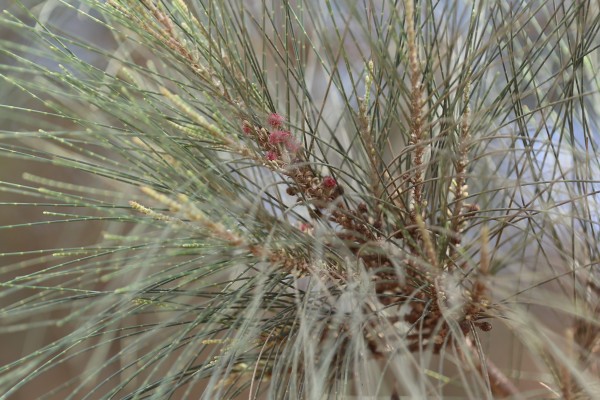
LEAVES: droopingbranchlets quite grey-green (glauca) and relatively thick withcharacteristic "joints" widely spaced, each a ring of about 15 scaleleaves (coarser and larger than in Casuarina equisetifolia).
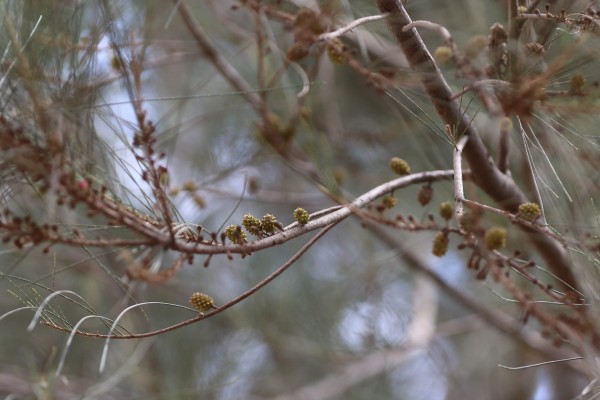
FLOWERS: male clusters with pollen along 2-4 cm of the tips of somebranchlets. Rounded female "cones" on stalked heads are hairywhen young, about 6 mm with dark red stigmas.
FRUIT: a woody multiple capsule, "cone-like",1-2 cm long and 1.0—1.5 cmwide, each individual fruit sharply pointed and opening to release1 pale winged nutlet.
Uses
An ornamental tree.
The bark can be used to plant orchids on.
Agroforestry: the plant suckers freely and forms a good windbreak, good for fence posts or shelterbelt, the low branching habit and extensive litter production helps to reduce soil erosion, leaves, seedlings, suckers and branchlets provide fodder to the animals, provides bee forage in terms of acting as a source of pollen, helps in nitrogen fixation in the soil.
Provides light construction, poles (building, transmission, piling), posts (including fencing).
Provides timber used for turnery, tool handles, rafters, flooring, fencing rails, shingles, and salt-water pilings.
The wood provides firewood and produces an excellent charcoal. It also makes good pellet-sized fuel.
Provides shade.
Ecology
A native of Australia from New South Wales to Queensland in a narrow coastal belt and also New Guinea. Casuarina glauca is most common along the edges of swampy flats, near estuaries and along tidal reaches of rivers. It has been the most successful Casuarina used in Israel. In Uganda the species is still under trial in the highlands of Kabale District. In Kampala, Casuarina glauca is located along Buganda road, Hesketh bell road, within Kibawo village, Tufnell Avenue, wampewo avenue etc.
Management
Moderately
fast-growing, coppices and produces root suckers vigorously.
Inoculation of seedlings with Frankia is recommended when introducing the
species to new areas.
Tree gallery
.jpg)
.jpg)
.jpg)