

Citrus limonia
Lemon, Mandarin lime
Luganda: Nimawa, nnimu.
Description
A small tree usually 3-6 m, rather open with stout stiff thorns. Young plants are more thorny.
BARK:
LEAVES: paler green than most citrus, oval and sharp tipped, 5-10 cm long, edge toothed, leaf stalk very short, its wing very narrow, and a clear joint to the leaf blade (articulation).
FLOWERS: produced at all seasons, white, solitary or clustered, petals thick and fragrant, back of petals purple-red so buds appear purple.
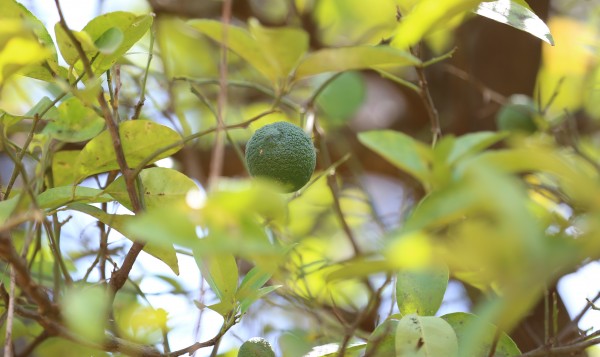
FRUIT : about 7-8 cm long, ovoid, pointed both ends, yellow or green when ripe, rough or smooth varieties, flesh pale yellow with much juice which is acid to bitter. Few seeds.
Uses
Edible: fruits, leaves, flowers. http://tropical.theferns.info/viewtropical.php id=Citrus+limon
Medicine: fruits and bark. http://tropical.theferns.info/viewtropical.php id=Citrus+limon
A semi-drying oil obtained from the seed is used in soap making.
An essential oil from the peel is used as a food flavouring and also in perfumery and medicines, though a higher quality essential oil is obtained from the flowers.
An essential oil obtained from the leaves and young twigs is called 'petitgrain oil'.
The dried fruit rind has been used as an insect repellent in the clothes cupboard and also in potpourri.
The juice of the fruit is used for polishing bronze and other metals that have been neglected. It can also be used for removing ink stains.
The fruit juice is used as a bleaching agent.
The plant is used as a rootstock for other Citrus species.
An ornamental tree.
Provides firewood.
Ecology
The lemon originated in south-eastern Asia. It was known to the Arabs in the tenth century and reached Europe by the thirteenth century. Columbus introduced it to Haiti on his second voyage in 1493. The Arabs introduced it into East and Central Africa. It is a tree suited to sandy or loamy well-drained soils. Lemon trees are commonly grown in Uganda and will grow at higher altitudes than some of the citrus but require well-distributed rainfall and high temperatures to fruit well. Humidity increases the risk of pests and diseases. In Kampala, Citrus limonia can be found within Sheraton gardens, Tuffnell village residences, Kitante courts, Uganda Golf course club among others.
Management
The lemon has proved its worth in Uganda: it does not suffer from the diseases common to other citrus and is a source of root stock material for budding of other Citrus species.
Tree gallery
.jpg)
.jpg)
.jpg)
.jpg)


