Thuja occidentalis
Eastern arborvitae, Arborvitae, American arborvitae, or White cedar
Description
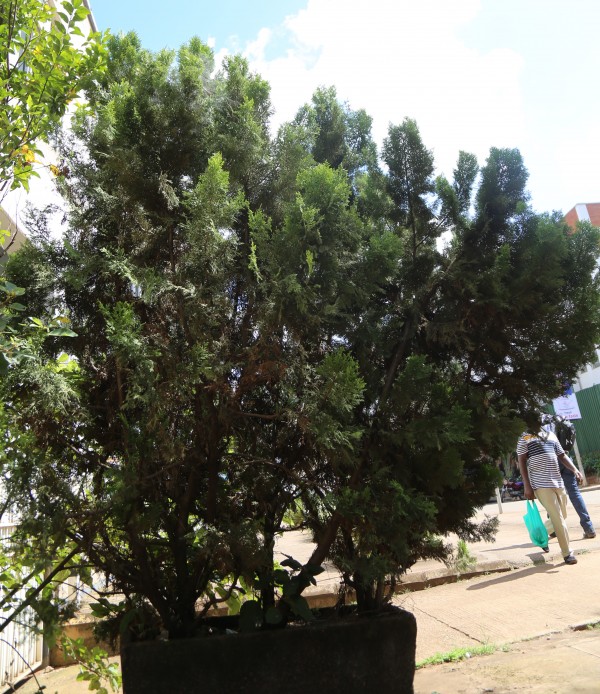
Small, medium, large, or very large evergreen shrub, depending upon cultivar. often maturing at about 6 meters tall by 2meters wide in urban landscapes. However, the species forms larger cultivars that can slowly get much bigger over time, to 15 meters tall by 5 meters wide, while dwarf cultivars can mature at 1 meter in height with a slightly wider width. Some forms are single-trunked or few-trunked, with lateral branches, while other forms are few- to many-trunked, with strongly ascending branches.
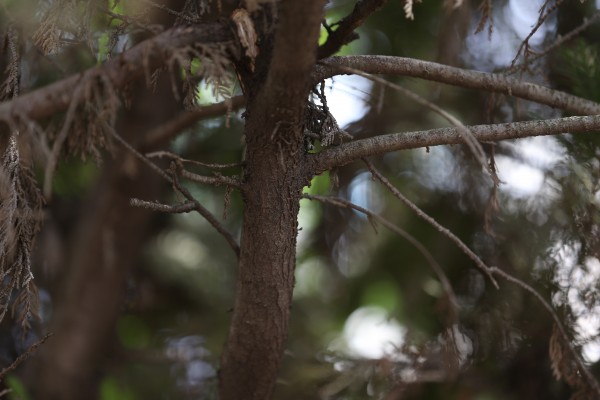
BARK: brownish-red bark exfoliates on mature branches or trunks, but is often hidden by the foliage of lower branches.
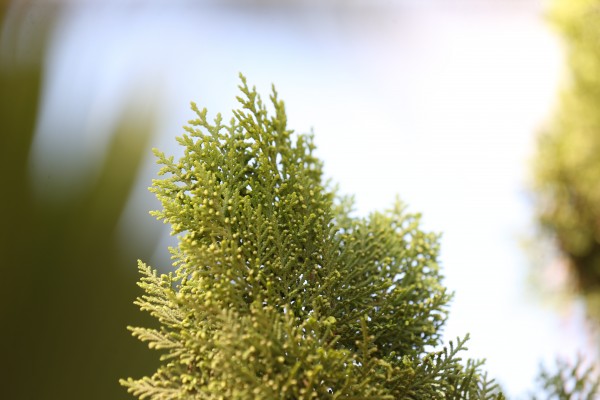
LEAVES: sprays of scale-like, dark green, miniature leaves are evergreen and held so tightly against the stems that the young twigs are often completely hidden. Foliage is highly scented if sheared.
FLOWERS: monoecious, male and female flowers usually borne on separate twigs or branchlets, tiny, terminal, cone-like bodies. Male flowers are yellowish and arise from branchlets near the base of the shoot; female flowers are pinkish and appear at the tips of short terminal branchlets.
FRUITS: ripe cones are pale cinnamon brown, oblong, and 8 -13 mm (0.3 – 0.5in). woody scales of mature cones enclosure double – winged seeds which are released the year after development.
Uses
Can be planted as a hedge.
An ornamental tree.
Medicine: leaves. https://www.webmd.com/vitamins/ai/ingredientmono-1117/thuja
Edible: thuja is used as a flavoring agent in foods and beverages.
Thuja is used as a fragrance in cosmetics and soaps.
Ecology
Thuja occidentalis is native to portions of the Eastern United. It is a common evergreen shrub having cultivars that are narrow pyramidal, columnar, or globed in shape, often found at entrance ways, at the corners of foundations, or as privacy screens in row plantings. It prefers a moist, well-drained, loamy soil in full sun, but tolerates soils that are poor, rocky, clay, compacted, dry, and of various pHs extremely well, and is very urban tolerant to heat, drought, humidity, and pollution; however, not tolerant of shady situations. In Kampala, American arborvitae can be found within Kitatnte courts, Makerere II zone C, along Acacia avenue among other places.
Management
Slow-growing tree. Transplanting is moderately easy if plants are root pruned and either balled and burlapped or potted.
Tree gallery