In January 2026, the African Resilience & Development Agency (AFRDA) ran the first cohort of its Community Outreach and Empowerment Program (COEP), a series of community-based agricultural trainings meant to give grassroots communities practical knowledge for more productive, profitable and sustainable farming. About eight months later, AFRDA’s Community Trainers of Trainers went back to Kisojo Sub-county in Kyenjojo District, Western Uganda, not to teach this time, but to see what had actually taken hold.
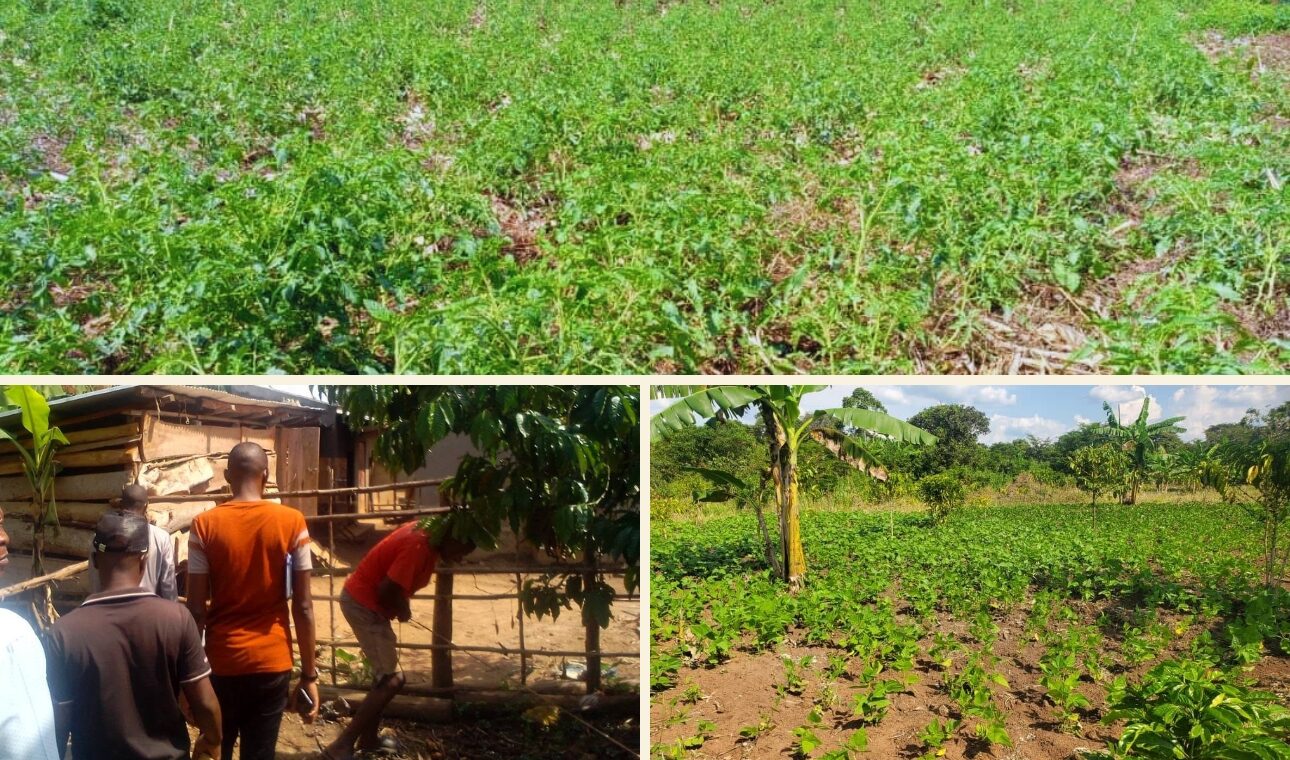
One of the people they visited was Charles Baguma, who had attended the January training. On roughly one acre of land, Charles now runs a diversified farming system that includes coffee, bananas, beans and tomatoes alongside livestock.
What stands out is not the number of crops but how they work together. Using intercropping and agronomic practices from the COEP training, Charles grows different crops on the same limited land, each serving a different household need or income stream. The livestock add another layer by providing milk and income and their manure goes back into the plantation as an organic source of nutrients. Rather than treating coffee, bananas, vegetables, legumes and livestock as separate enterprises, the farm functions more as one connected production system.
FAO lists diversity, recycling, efficiency and synergy among the core features of agroecological farming systems and notes that integrated crop-livestock systems can help nutrients circulate within a farm including through the use of manure, while giving farming households more diverse ways to earn a living. Along similar lines, the International Institute of Tropical Agriculture has pointed out that banana-coffee intercropping, managed properly, can be more profitable and more resilient than growing either crop on its own. Charles’s farm is a small-scale example of these ideas in practice.
What this means beyond one farm
Charles’s experience is just one household’s, but it reflects what AFRDA is aiming for with its community-based approach more broadly. The goal isn’t to hand every community the same farming model because conditions, resources, markets and household priorities differ too much for that. Instead, AFRDA focuses on equipping communities with practical principles they can adapt to their own circumstances such as intercropping, soil fertility management, diversification, resource efficiency and integrated farming.
Sustainable agricultural development comes from knowledge that communities understand, apply and pass on themselves. Eight months after the first COEP cohort, this small farm in Kyenjojo proves than an acre is a fixed amount of land, but what a farmer can do with it isn’t fixed at all. With the right knowledge, even a small plot can become a source of food, income, healthier soil and a more resilient livelihood, one farmer, one farm, at a time.