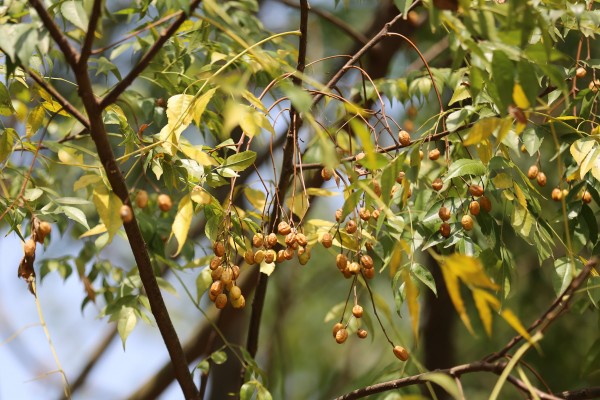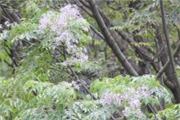
Melia azedarach
Bead tree, Persian lilac, China berry, China tree, Pride of China, Pride of India, Syringa, Azedarach, White cedar
Luganda: Lira Lugbara: Lira.
Description
A small tree 5-6 m, but can reach 10 m, usually deciduous, with a thin trunk.
BARK: grey, smooth, later rough and brown, branchlets dotted with breathing pores.
LEAVES: bi-pinnate, on branched stalks, to 40 cm long, up to 6 pairs of pinnae and 3-9 leaflets, each one bright shiny green, narrow to 8 cm, the edge irregularly toothed, the tip long and pointed.
FLOWERS: fragrant in large rounded clusters to 25 cm, each flower with 5 pale purple-white petals and a dark purple center.
FRUIT: fleshy yellow-orange, oval to 1.5 cm, persisting on the bare tree. Each fruit contains a stone with 4-6 dark brown seeds inside.
Uses
Medicine: leaf juice, leaves, flowers, fresh or dried stem bark, fresh or dried root bark, fruit, seed, and gum. http://tropical.theferns.info/viewtropical.php id=Melia+azedarach
Edible: leaves are used as a pot-herb, in curries, soups etc., cooling drink is made from the sap. http://tropical.theferns.info/viewtropical.php id=Melia+azedarach
Agroforestry: can beplanted as a wind break, can be used in reforestation projects to restore native woodland, can be grown as a shade tree in coffee and abaca (Musa textilis) plantations, leaves are lopped for fodder, used in apiculture (bee forage).
The seed contains up to 40% of a drying oil which is used for lighting, varnish etc.
The musk-scented seeds are used as beads in rosaries.
A red dye is obtained from the bark.A fiber obtained from the bark is used to make ropes.
The fruits are source of a flea powder and an insecticide.
The fruit pulp is also used as an insect repellent. Aqueous and alcoholic extracts of the leaves and seeds can control many insects, mites and nematode pests.
The leaves repel mosquitoes and other insects.
The wood is used for making furniture, packing cases, construction, decorative veneer etc.
It is also used to manufacture agricultural implements, furniture, plywood, boxes, poles, tool handles, cabinet making and in construction because of its resistance to termites.
An ornamental tree.
Provides fuel and can be used to make charcoal.
Provides poles and posts.
Ecology
Persian lilac is native to Western Asia, Himalayas. A popular ornamental exotic long planted in the tropics and subtropics. It grows on most soils, both acidic and saline from the coast to 2,000 m. It has been recommended for fuel and pole production in dry areas being drought resistant. It grows well in drier areas of Uganda and is the common tree with foliage during the dry season in Moroto District. Its popular also in Arua District. In Kampala, Persian lilac can be found within Uganda Golf course club, Makerere University, along Acacia avenue, Upper Kololo terrace among other places.
Management
Fairly fast growing; pollarding, lopping,
coppicing, pruning
Tree gallery
.jpg)
.jpg)
.jpg)
.jpg)