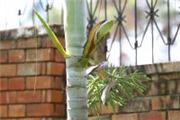
Spathodea campanulata (S. nilotica)
Flame of the forest, Nandi flame, Nile flame, Uganda flame, tulip tree
Luganda: Kifabakazi Kwamba: Kikusi, kigima, abadu Lugishu: Kichubi, kijubu Lugwe: Mudungudungu Lunyuli: Mungobe Luo A: LepengwataLuo L: Opal, elwa Rukiga: Ekifurafura Runyankore: Munyara Runyoro: Munyara, ekinyara Rutoro: Murogorogoro Sebei: Chemungwa., Ateso: Etukubai.
Description
African tulip tree is an evergreen or semi-deciduous tree with a dense, bushy, oval crown; it can grow from 10 - 35 meters tall. The stem tends to become hollow, dropping large branches as the tree ages.
BARK: pale grey-brown and smooth, rough with age.
LEAVES: compound to 40 cm long, 6 pairs of leaflets, each wavy, tip pointed plus a central leaflet. Yellow-brown hairs on shoots, buds, branchlets and underside of leaves.
FLOWERS: fiery orange-red clusters stand out all over the tree, a yellow edge on the frilly petals; a yellow-flowering variety exists. Furry buds contain watery liquid.
FRUIT: brown woody capsules to 25 cm split on the ground releasing many flat winged seeds.
Uses
Medicine: unopened flower buds, the bark, roots, leaves and flowers. http://tropical.theferns.info/viewtropical.php id=Spathodea+campanulata , https://uses.plantnet-project.org/en/Spathodea_campanulata_(PROTA)
Agroforestry: the tree is planted for soil improvement, reforestation, erosion control and land rehabilitation, and also as a live fence, leaves make a useful mulch, used as a shade tree in coffee plantations.
Provide timber which can be used for carving.
The wood is used for fuel and to make charcoal.
African tulip tree is planted as an ornamental, a wayside tree and shade tree.
Ecology
Native to tropical western Africa (i.e. Burundi, Cameroon, Equatorial Guinea, Gabon, Rwanda, Zaire, Benin, Ivory Coast, Ghana, Guinea, Liberia, Nigeria, Sierra Leone, Togo and Angola). A decorative tree of forest fringe and a pioneer species, common from Uganda to West Africa and widely planted throughout the tropics from sea level up to 2,000 m. Once established it is drought resistant. In Kampala, Nandi flame can be found along Archer road, around the Constitutional square, within Uganda Golf course club, Makerere University among other places.
Management
Fairly fast growing. Pollarding.
Tree gallery
.JPG)