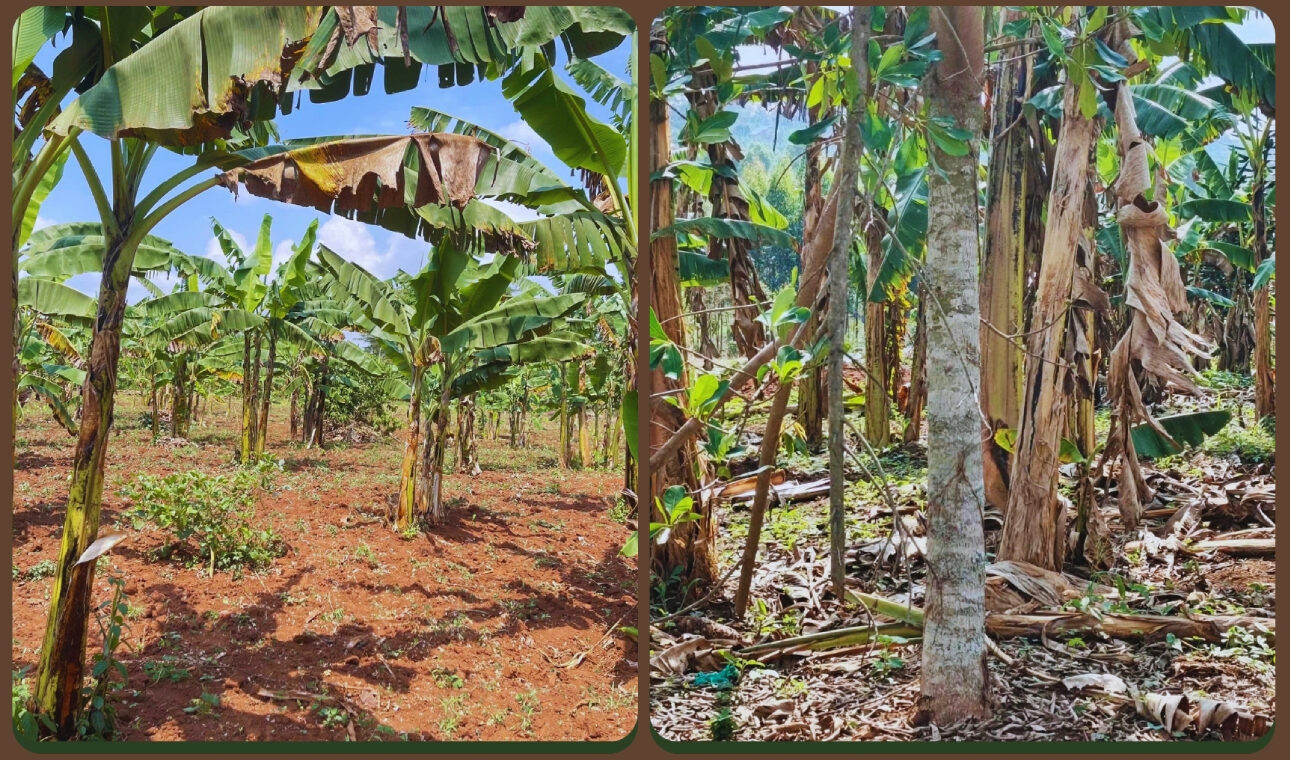
Can we grow good food while leaving the soil undisturbed? That is the question our team has been investigating alongside smallholder banana farmers in Kinuuka Sub-county, Lyantonde District and here is a midpoint update on what we are learning.
Why this research matters
Tillage is deeply embedded in traditional farming practice across Uganda, valued for loosening soil and controlling weeds ahead of planting. But for perennial crops like banana, repeated tillage carries a hidden cost. Banana root systems are concentrated in the top 30 centimetres of soil and studies across East Africa’s highland banana systems show that as much as 80% of the water a banana plant takes up is drawn from this shallow topsoil layer. Routine cultivation in this zone repeatedly disturbs and prunes an important fraction of the root system, at a time when many of the region’s soils are already low in fertility and rainfall is unevenly distributed through the year.
At the same time, tillage speeds up the breakdown of soil organic matter and leaves bare soil exposed to erosion, particularly on the sloped, rain-fed smallholdings typical of most parts of Uganda that grow bananas. Over successive seasons, this can compound soil degradation and contribute to the long-term decline in banana productivity that has been documented across the region.
About the trial
Since January 2026, AFRDA has been working with a group of smallholder farmers in Kinuuka Sub-county to establish paired banana plots with one managed under conventional periodic tillage and the other under a no-till system relying on mulch retention and minimal soil disturbance at planting. The goal is to determine whether no-till banana production can deliver soil conservation benefits without sacrificing yield relative to conventional tillage and ideally to see whether it can match or exceed it.
Our monitoring tracks plant establishment and vigor, canopy development, weed pressure, visible soil cover and erosion indicators and as the trial matures toward harvest, we shall add bunch formation and yield.
What we are observing so far
At this midpoint, the picture from the field is encouraging. The no-till plots show healthy, uniform plant stands with strong canopy development, visible organic mulch cover protecting the soil surface and no signs of erosion or bare-soil exposure, even without the disturbance of periodic cultivation and the weed pressure has remained manageable under the mulch layer. These are visual and agronomic field observations, not yield data because we have not reached harvest yet, so any claims about comparative yield would be premature. What we can say is that, so far, the no-till system shows no signs of compromising plant health or productivity potential relative to expectations for the tilled comparison plots.
Over the coming months, we will continue monitoring both plots through to bunch maturity and harvest, at which point we shall be able to report comparative yield data, along with soil sampling results on organic matter and moisture retention. We plan to share a full findings report once the trial concludes, including practical guidance for farmers considering the practice.
If the results hold, no-till banana production could offer smallholder farmers in Lyantonde District, Uganda and beyond a way to conserve soil health and reduce labor inputs without trading away productivity which would be a meaningful step toward more resilient food systems in the region. We are grateful to the farmers in Kinuuka Sub-county partnering with us on this work.